Block diagram
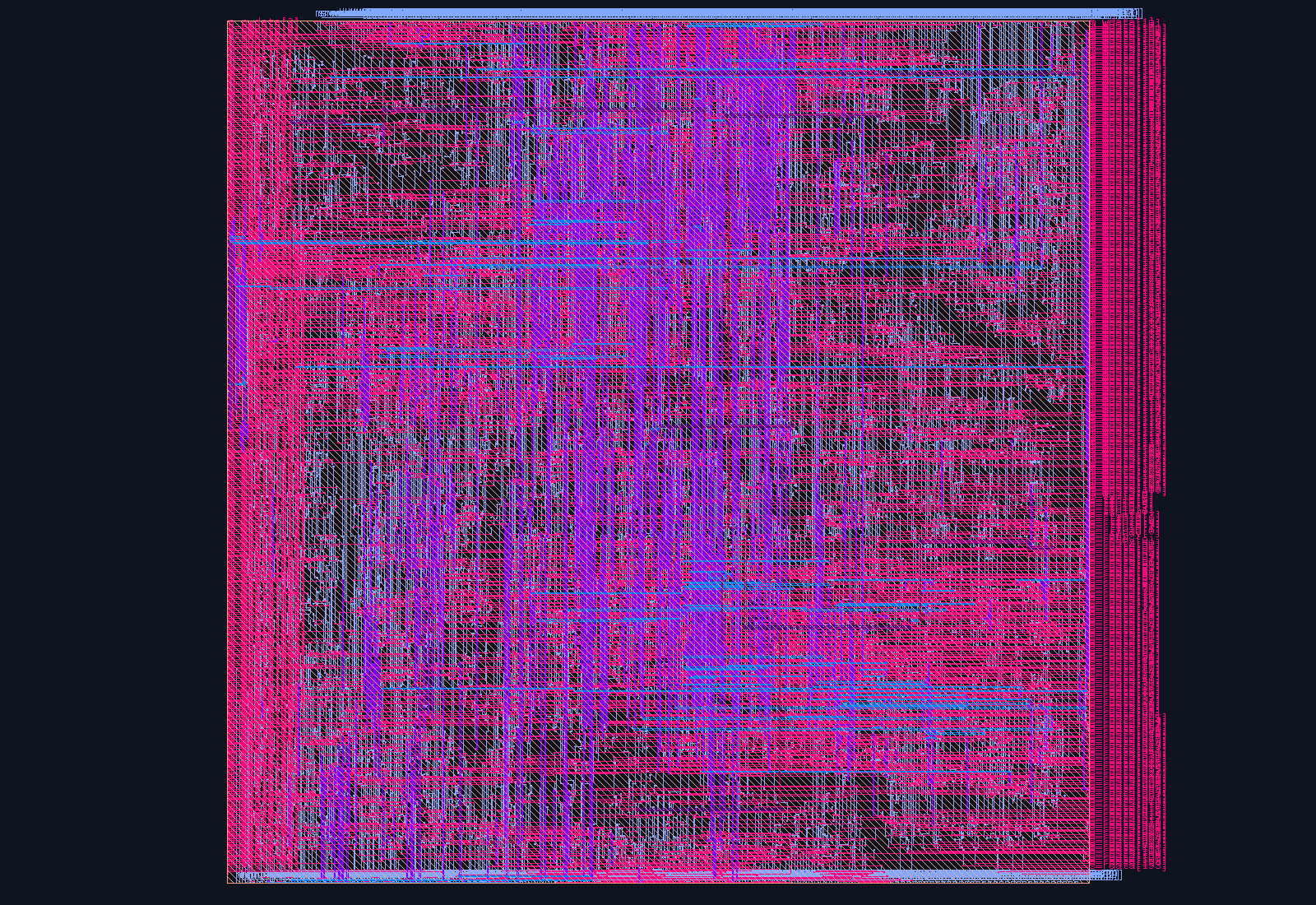
Physical implementation
What you’re licensing
The memory-side leg of the AMBA 5 CHI node triad — end-to-end SECDED between the Home Node and DRAM, multi-outstanding tagged reads… It is delivered as a licensable soft-IP block engineered as an ASIL-B Safety Element out of Context — not just RTL, but the complete functional-safety work package needed to carry it into an ISO 26262 program:
What it is
chi_sn_f is the CHI Slave Node (SN-F) memory endpoint that completes the coherent CHI node triad the catalog already ships (RN-F -> HN-F -> SN-F): it terminates the tagged memory-side port a CHI Home Node drives and bridges it to a downstream memory controller with end-to-end SECDED.
Key Features
- End-to-end SECDED memory endpoint: ecc_pkg::ecc_enc64 encodes every 64-bit sub-word of the 256-bit line on write, ecc_dec64 corrects single-bit / flags double-bit upsets on read (err_code 2)
- Multi-outstanding reads: up to N_OUT (default 8) reads tracked in a tagged FIFO, each returned in issue order paired with its originating TxnID; writes are posted (accept = retirement, no separate completion signal)
- Direct mem_* mirror of chi_hn_f’s memory-side master port (ADDR_W=44, DATA_W=256) — plugs into the catalog’s coherent_fabric_v3/v4 tops with no adapter
- Silicon-complete downstream chain via sn_to_lpddr5 (256<->64 AXI4 burst adapter) into the real lpddr5_ctrl memory controller and its DFI PHY
- Request-address even parity, continuously re-checked at rest while a read is outstanding (err_code 1); downstream bus error surfaced as a fault AND propagated to the HN as a CHI read error (err_code 3)
- Outstanding-read watchdog, default 4096 cycles (err_code 4); outstanding-FIFO write-pointer complementary diverse-DMR shadow (err_code 9)
- Formal bmc (pointer-DMR clean, no FIFO overflow, tagged-return invariant) + cover (multi-outstanding reachable)
Standards & Compliance
Arm AMBA 5 CHI (Issue E, SN-F memory-side role); ISO 26262 ASIL-B SEooC
Functional Safety
ASIL-B (SEooC) · SPFM 91.97% · LFM 90.31% · PASS
ISO 26262:2018 · FMEDA available · Safety Manual included
Register Map
| Offset | Register | Description |
|---|---|---|
0x00 | CTRL | RW [0]=EN (accept requests) |
0x0C | STATUS | RO [0]=busy (reads in flight) [3:1]=fifo occupancy [6:4]=err_code[2:0] [7]=err_valid |
Getting Started
// Minimal instantiation
chi_sn_f #(
 .ADDR_W(6)
) u_chi_sn_f (
 .clk (clk),
 .rst_n (rst_n),
 // APB4
 .p_paddr (paddr),
 .p_psel (psel),
 .p_penable (penable),
 .p_pwrite (pwrite),
 .p_pwdata (pwdata),
 .p_prdata (prdata),
 .p_pready (pready),
 // Safety
 .err_clear (1'b0),
 .err_valid (err_valid),
 .err_code (err_code)
);
Configure via the CTRL register after reset to enable the IP and set operating parameters. Monitor err_valid / err_code for any safety faults reported by the built-in safety monitor.
Where it fits
Typically deployed in multi-core compute clusters that need cache coherency with a defensible ordering proof.
Why license it, not build it
Interested in CHI Slave Node — Memory Endpoint (SN-F)?
Pricing, the per-IP FMEDA, safety manual, and RTL data room are shared under a mutual NDA.
Figures are pre-silicon engineering-grade estimates for a Safety Element out of Context (SEooC); final ASIL sign-off is the integrator’s, supported under NDA. FMEDA and Safety Manual available under NDA.
circuit-design.space · +1-971-357-1400 · anovickis@circuit-design.space