Block diagram
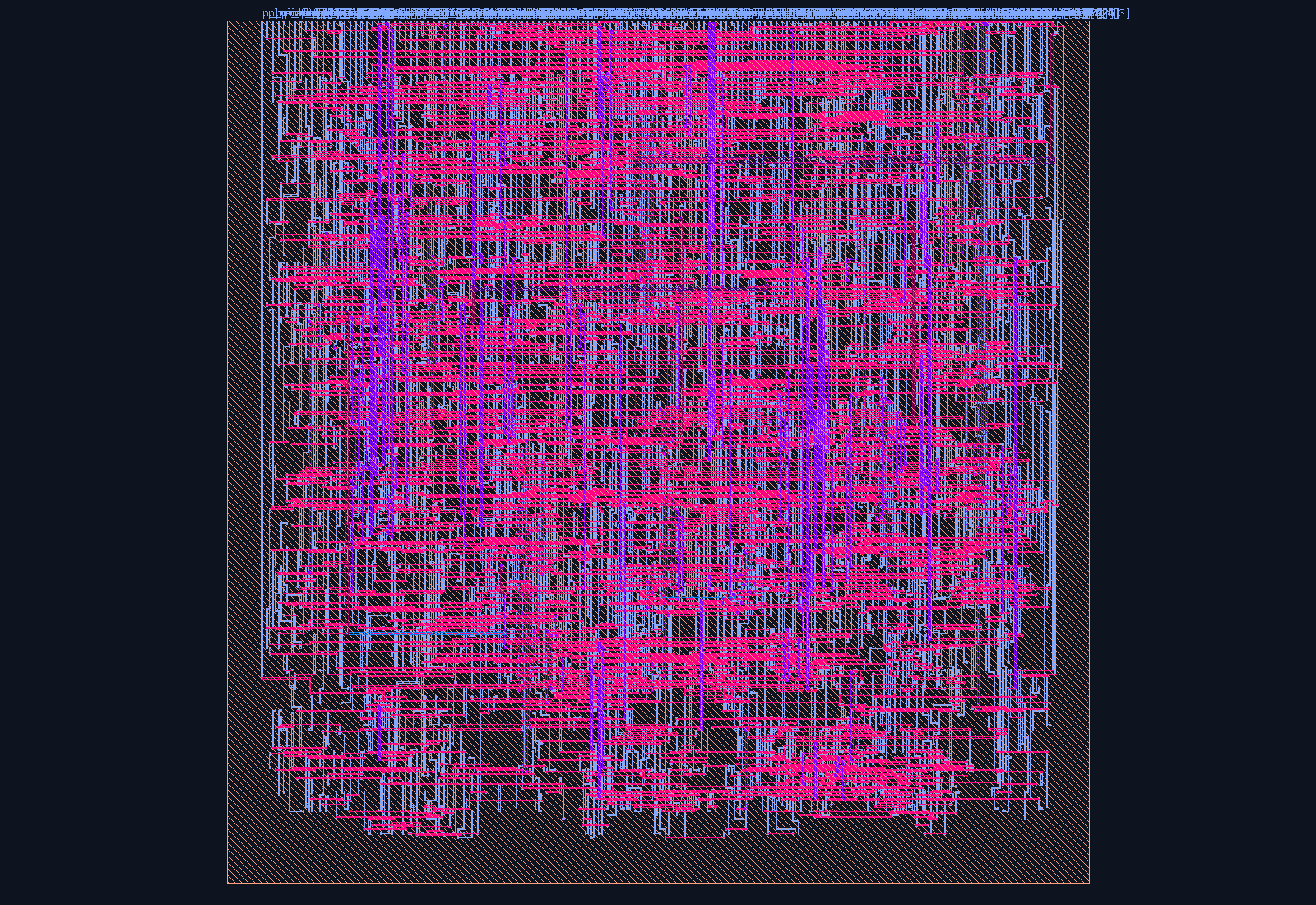
Physical implementation
What you’re licensing
Vectored, preemptive RISC-V CLIC with a fixed one-cycle request latency and triple-layered interrupt-integrity checking, ASIL-B. It is delivered as a licensable soft-IP block engineered as an ASIL-B Safety Element out of Context — not just RTL, but the complete functional-safety work package needed to carry it into an ISO 26262 program:
What it is
A RISC-V CLIC (Core-Local Interrupt Controller) delivered as synthesizable SystemVerilog soft-IP.
Key Features
- Per-interrupt CLICINTIE enable, CLICINTIP pending, 4-bit CLICINTCTL level/priority and CLICINTATTR vectored attribute; NUM_IRQ parameterizable, v0.1 tested to 8
- Fixed one-cycle request latency: pending is the only registered stage, arbitration is fully combinational off it, so a synchronized source reaches irq_req deterministically — an FTTI-analyzable constant, not a polling loop
- Highest-level arbitration with highest-id tie-break (CLIC spec precedence); CLICCLAIM read returns the winning id and atomically clears its pending bit, re-pending next cycle if the level line is still asserted
- Level-based preemption via CLICMTH machine threshold — only interrupts strictly above threshold are eligible; software raises CLICMTH on ISR entry and restores it on exit to nest correctly
- ASIL-B: pending latch + arbitration carry a complementary DMR shadow (err_code 9, pend_t == ~pend_c)
- ASIL-B: per-interrupt even parity over the level/enable/attr/threshold routing table catches an in-nibble upset a whole-register parity bit would miss (err_code 1)
- ASIL-B: threshold/level plausibility check on the arbitration output (err_code 3) plus lvl_fi_i/pend_fi_i/sel_fi_i DFT injection hooks exercise each mechanism
Standards & Compliance
RISC-V CLIC (Core-Local Interrupt Controller) specification, AMBA APB4-lite; ISO 26262 ASIL-B SEooC
Functional Safety
ASIL-B (SEooC) · SPFM 93.00% · LFM 99.00% · PASS
ISO 26262:2018 · FMEDA available · Safety Manual included
Register Map
| Offset | Register | Description |
|---|---|---|
0x00 | CLICCFG | config (RW; nlbits etc — stored, informational in v0.1) |
0x04 | CLICINTIP | per-IRQ pending [NUM_IRQ-1:0] RO |
0x08 | CLICINTIE | per-IRQ enable [NUM_IRQ-1:0] |
0x0C | CLICINTATTR | per-IRQ vectored attr [NUM_IRQ-1:0] (bit i = vectored) |
0x10 | CLICINTCTL | 4 bits/IRQ packed level/priority (0 = lowest) |
…2 more registers — see datasheet for the full table.
Getting Started
// Minimal instantiation
clic #(
 .ADDR_W(6)
) u_clic (
 .clk (clk),
 .rst_n (rst_n),
 // APB4
 .p_paddr (paddr),
 .p_psel (psel),
 .p_penable (penable),
 .p_pwrite (pwrite),
 .p_pwdata (pwdata),
 .p_prdata (prdata),
 .p_pready (pready),
 // Safety
 .err_clear (1'b0),
 .err_valid (err_valid),
 .err_code (err_code)
);
Configure via the CTRL register after reset to enable the IP and set operating parameters. Monitor err_valid / err_code for any safety faults reported by the built-in safety monitor.
Where it fits
Typically deployed in RISC-V SoCs that need a safety-grade core, boot, memory, debug, and interrupt platform.
Why license it, not build it
Interested in RISC-V CLIC (Core-Local Interrupt Controller)?
Pricing, the per-IP FMEDA, safety manual, and RTL data room are shared under a mutual NDA.
Figures are pre-silicon engineering-grade estimates for a Safety Element out of Context (SEooC); final ASIL sign-off is the integrator’s, supported under NDA. FMEDA and Safety Manual available under NDA.
circuit-design.space · +1-971-357-1400 · anovickis@circuit-design.space