Block diagram
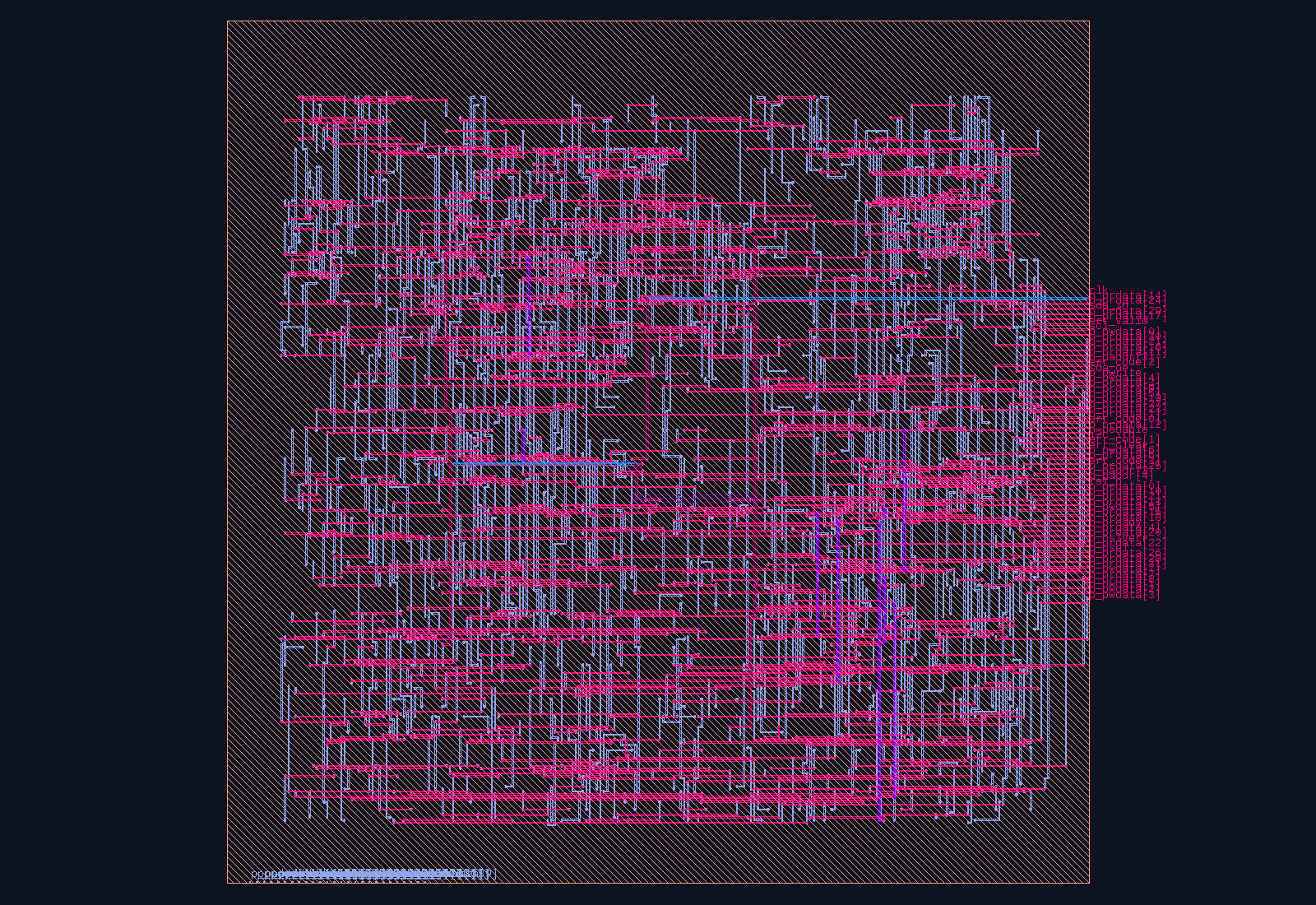
Physical implementation
What you’re licensing
Addressable I²C slave — open-drain SDA/SCL, ASIL-B lockstep FSM, integration-ready. It is delivered as a licensable soft-IP block engineered as an ASIL-B Safety Element out of Context — not just RTL, but the complete functional-safety work package needed to carry it into an ISO 26262 program:
A synthesizable 7-bit I2C slave soft-IP — the counterpart to ip/i2c_master. It detects START/STOP, matches its programmed address, ACKs, and exchanges bytes with an external I2C master (host write → RXDATA, host read ← TXDATA) over an open-drain SDA/SCL pair.
Key Features
- 7-bit address match against a configurable ADDR register; a non-matching address NACKs and releases the bus (silent, multi-drop-safe)
- Open-drain sda_oe pull-low enable (no internal pull-up); SCL/SDA double-flopped into clk for metastability-safe edge and START/STOP detection
- Master write → RXDATA, with RX_READY and a write-1-to-clear OVERRUN if the prior byte was not read before the next completed
- Master read ← TXDATA, shifted out MSB-first with the bus released each byte for the master’s ACK/NACK
- No clock stretching in v0.1 (SCL is input-only) — host must service the single-byte buffer at the bus rate
- Config-register (CTRL/ADDR) even parity into safety_monitor (err_code 1); latched TXDATA/RXDATA data-byte parity (err_code 2)
- Diverse complementary-DMR lockstep across the FSM state, bit counter, and RX/TX shift registers (err_code 9)
Standards & Compliance
NXP I²C-bus Specification UM10204 Rev. 7 (slave/target mode); ISO 26262 ASIL-B SEooC
Functional Safety
ASIL-B (SEooC) · SPFM 93.33% · LFM 99.00% · PASS
ISO 26262:2018 · FMEDA available · Safety Manual included
Register Map
| Offset | Register | Description |
|---|---|---|
0x00 | CTRL | [0]=EN 0x04 ADDR [6:0]=7-bit slave address |
0x08 | STATUS | [0]=RX_READY [1]=ADDRESSED [2]=OVERRUN(W1C) [3]=RW_DIR |
0x0C | TXDATA | 0x10 RXDATA (read clears RX_READY) 0x14 IER [0]=RX_IE |
Getting Started
// Minimal instantiation
i2c_slave #(
 .ADDR_W(6)
) u_i2c_slave (
 .clk (clk),
 .rst_n (rst_n),
 // APB4
 .p_paddr (paddr),
 .p_psel (psel),
 .p_penable (penable),
 .p_pwrite (pwrite),
 .p_pwdata (pwdata),
 .p_prdata (prdata),
 .p_pready (pready),
 // Safety
 .err_clear (1'b0),
 .err_valid (err_valid),
 .err_code (err_code)
);
Configure via the CTRL register after reset to enable the IP and set operating parameters. Monitor err_valid / err_code for any safety faults reported by the built-in safety monitor.
Where it fits
Typically deployed in in-vehicle networks, industrial gateways, and sensor/actuator links where a bus controller has to carry its own safety argument.
Why license it, not build it
Interested in I²C Slave Controller?
Pricing, the per-IP FMEDA, safety manual, and RTL data room are shared under a mutual NDA.
Figures are pre-silicon engineering-grade estimates for a Safety Element out of Context (SEooC); final ASIL sign-off is the integrator’s, supported under NDA. FMEDA and Safety Manual available under NDA.
circuit-design.space · +1-971-357-1400 · anovickis@circuit-design.space