Block diagram
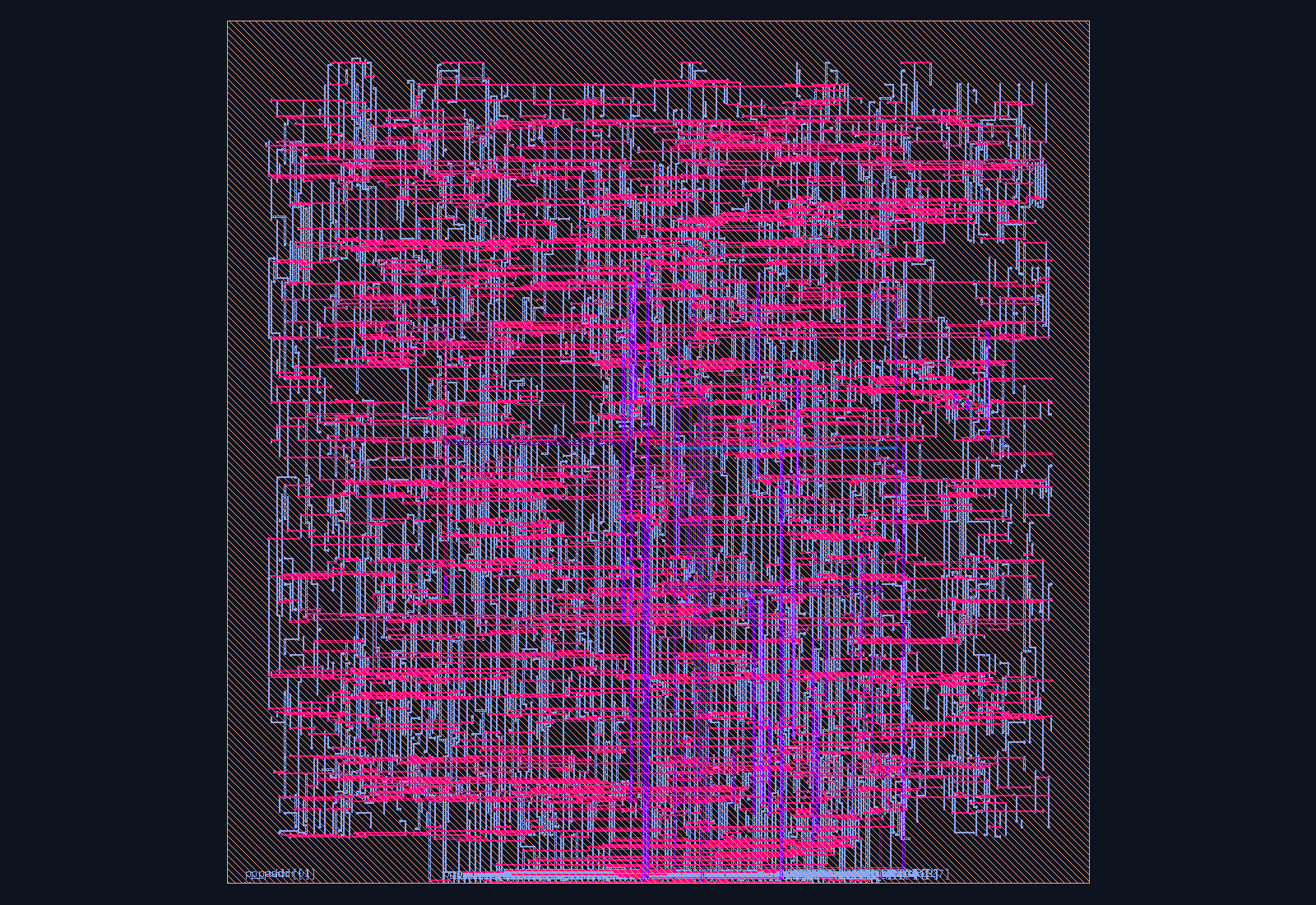
Physical implementation
What you’re licensing
APB4 mailbox + test-and-set spinlock unit for safety-island ↔ application-core handshakes, ASIL-B via resident parity + complementary-DMR. It is delivered as a licensable soft-IP block engineered as an ASIL-B Safety Element out of Context — not just RTL, but the complete functional-safety work package needed to carry it into an ISO 26262 program:
Mbox — Introduction
What it is
mbox is a multicore mailbox and hardware spinlock/semaphore unit: NMBOX 32-bit mailboxes for post/consume message passing with an IRQ doorbell, plus NLOCK hardware test-and-set spinlocks, behind one APB4 slave with ASIL-B parity and complementary-DMR safety instrumentation.
Key Features
- NMBOX 32-bit post/consume mailboxes: a write posts a message (sets valid, raises mbox_irq if IRQ-enabled), a read returns it and clears valid (consume/ack semantics)
- NLOCK hardware test-and-set spinlocks: a single atomic APB read acquires the lock and returns the previous value; a write of 0 releases it — classic HW mutex, no software CAS loop needed
- mbox_irq is the level-OR of valid & IRQ_EN across all mailboxes, so a consuming read of the posted mailbox always clears that source’s contribution
- ASIL-B resident + delivered-read parity on every mailbox word (checked continuously across all NMBOX words and again on the value actually leaving the read mux) → err_code 1/2
- ASIL-B complementary-DMR shadows on lock state, valid bits, and the IRQ-enable register, plus a diverse decode/read-mux copy catching a misrouted mailbox or lock access → err_code 9
- Zero-wait-state APB4 slave (p_pready=1, p_pslverr=0); every access completes in one cycle, no FSM
Standards & Compliance
AMBA APB4 (ARM IHI 0024); ISO 26262 ASIL-B SEooC
Functional Safety
ASIL-B (SEooC) · SPFM 95.69% · LFM 99.00% · PASS
ISO 26262:2018 · FMEDA available · Safety Manual included
Register Map
| Offset | Register | Description |
|---|---|---|
0x00..0x0C | MBOX0..3 | RW write posts (valid+IRQ); read returns + clears valid |
0x10 | MBOX_STAT | RO [NMBOX-1:0] valid bits |
0x14 | IRQ_EN | RW [NMBOX-1:0] per-mailbox IRQ enable (parity-protected) |
0x20..0x2C | LOCK0..3 | R=test-and-set acquire (returns prev in bit0); W bit0=0 release |
0x30 | LOCK_STAT | RO [NLOCK-1:0] lock bits |
Getting Started
// Minimal instantiation
mbox #(
 .ADDR_W(6)
) u_mbox (
 .clk (clk),
 .rst_n (rst_n),
 // APB4
 .p_paddr (paddr),
 .p_psel (psel),
 .p_penable (penable),
 .p_pwrite (pwrite),
 .p_pwdata (pwdata),
 .p_prdata (prdata),
 .p_pready (pready),
 // Safety
 .err_clear (1'b0),
 .err_valid (err_valid),
 .err_code (err_code)
);
Configure via the CTRL register after reset to enable the IP and set operating parameters. Monitor err_valid / err_code for any safety faults reported by the built-in safety monitor.
Where it fits
Typically deployed in RISC-V SoCs that need a safety-grade core, boot, memory, debug, and interrupt platform.
Why license it, not build it
Interested in Inter-Core Mailbox + Hardware Spinlock?
Pricing, the per-IP FMEDA, safety manual, and RTL data room are shared under a mutual NDA.
Figures are pre-silicon engineering-grade estimates for a Safety Element out of Context (SEooC); final ASIL sign-off is the integrator’s, supported under NDA. FMEDA and Safety Manual available under NDA.
circuit-design.space · +1-971-357-1400 · anovickis@circuit-design.space