Block diagram
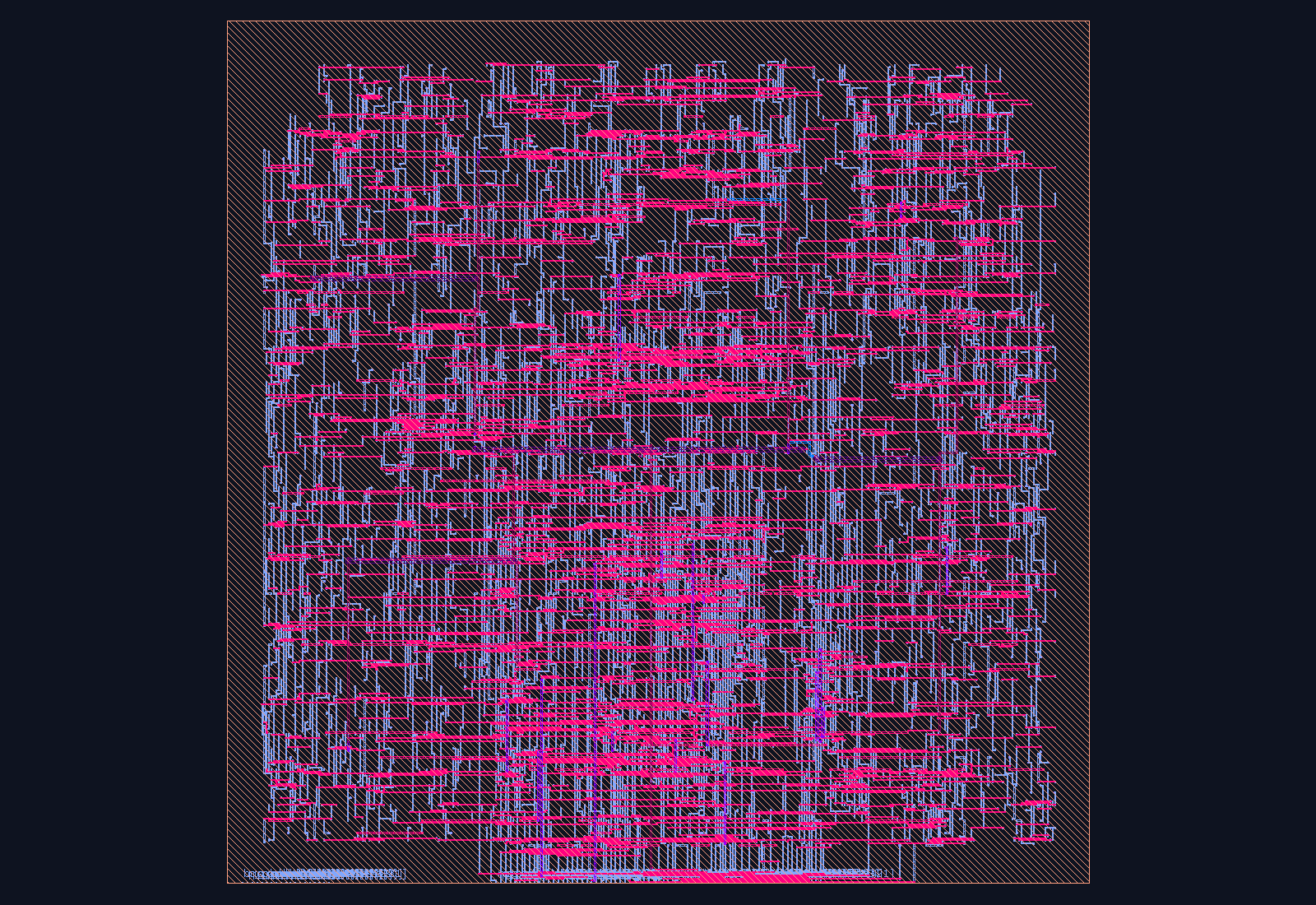
Physical implementation
What you’re licensing
MIL-STD-1553B Remote Terminal controller, Manchester II framing + dual-redundant bus inputs, ASIL-B / DO-254-ready. It is delivered as a licensable soft-IP block engineered as an ASIL-B Safety Element out of Context — not just RTL, but the complete functional-safety work package needed to carry it into an ISO 26262 program:
What it is
A configurable MIL-STD-1553B Remote Terminal (RT) controller delivered as synthesizable SystemVerilog soft-IP.
Key Features
- Manchester II bi-phase-L encode/decode (1 = H→L, 0 = L→H) with a programmable half-bit period (MAN_HALF = clk_Hz/2e6 for the standard 1 Mbps rate) and sync-pattern classification (command/status vs. data) by 1.5-bit-time level duration
- RT protocol FSM (IDLE→RX_CMD→{RX_DATA×WC→TX_STATUS | TX_STATUS→TX_DATA×WC}) decodes RTADDR/T_R/SUBADDR/WORDCNT, answers only commands addressed to its own 5-bit RTADDR, and streams up to 32 data words per message (WORDCNT=0 decodes as 32 words per 1553B)
- Dual-redundant bus inputs (bus_a_i/bus_b_i), each independently 2-FF synchronized, terminating at the decoded Manchester level — the transformer-coupled transceiver is external; v0.1 locks the receive mux to bus A at reset, with dynamic first-valid-sync arbitration slated for a later revision
- Odd-parity + sync-pattern word-level fault detection funnels into the ERR register and the shared safety_monitor as err_code 3
- Even-parity protection on the CTRL/RTADDR config registers reports as err_code 1
- Complementary-DMR lockstep shadow on the RT protocol FSM — an independent next-state cone compared every cycle — reports any divergence as err_code 9
- APB4 register map (4-byte stride): CTRL 0x00, STATUS 0x04, RTADDR 0x08, CMD 0x0C, RXDATA 0x10, TXDATA 0x14, IER 0x18, ISR 0x1C (W1C), ERR 0x20 (W1C)
Standards & Compliance
MIL-STD-1553B (Manchester II, 1 Mbps, dual-redundant bus A/B); DO-254/ED-80 airborne electronic hardware design-assurance framing; ISO 26262 ASIL-B SEooC
Functional Safety
ASIL-B (SEooC) · SPFM 97.85% · LFM 99.00% · PASS
ISO 26262-5 FMEDA method (transferable evidence for the RTCA DO-254 assurance case) · FMEDA available · Safety Manual included
Register Map
| Offset | Register | Description |
|---|---|---|
0x00 | CTRL | 0x04 STATUS 0x08 RTADDR 0x0C CMD 0x10 RXDATA |
0x14 | TXDATA | 0x18 IER 0x1C ISR(W1C) 0x20 ERR(W1C) [1]TXDATA_REQ [0]RX_VALID |
Getting Started
// Minimal instantiation
mil1553 #(
 .ADDR_W(6)
) u_mil1553 (
 .clk (clk),
 .rst_n (rst_n),
 // APB4
 .p_paddr (paddr),
 .p_psel (psel),
 .p_penable (penable),
 .p_pwrite (pwrite),
 .p_pwdata (pwdata),
 .p_prdata (prdata),
 .p_pready (pready),
 // Safety
 .err_clear (1'b0),
 .err_valid (err_valid),
 .err_code (err_code)
);
Configure via the CTRL register after reset to enable the IP and set operating parameters. Monitor err_valid / err_code for any safety faults reported by the built-in safety monitor.
Where it fits
Typically deployed in avionics, defense, and space systems built to the ARINC, MIL-STD, and CCSDS standards.
Why license it, not build it
Interested in MIL-STD-1553B Remote Terminal (RT) Controller?
Pricing, the per-IP FMEDA, safety manual, and RTL data room are shared under a mutual NDA.
Figures are pre-silicon engineering-grade estimates for a Safety Element out of Context (SEooC); final ASIL sign-off is the integrator’s, supported under NDA. FMEDA and Safety Manual available under NDA.
circuit-design.space · +1-971-357-1400 · anovickis@circuit-design.space