Block diagram
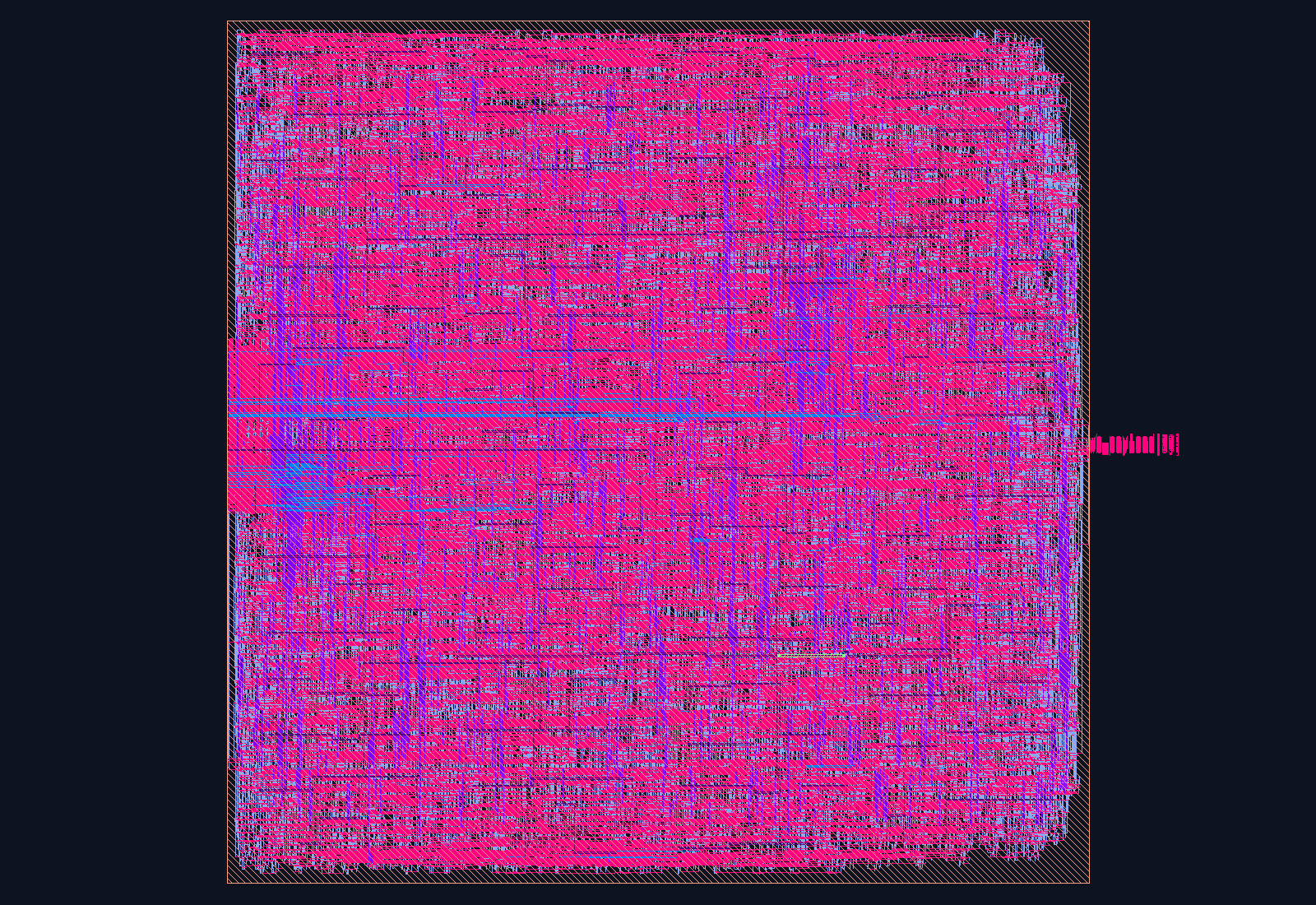
Physical implementation
What you’re licensing
Byte-parity protection for an out-of-order core’s reorder buffer, checked at the in-order commit edge, ASIL-B via a no-vendor XiangShan overlay kit. It is delivered as a licensable soft-IP block engineered as an ASIL-B Safety Element out of Context — not just RTL, but the complete functional-safety work package needed to carry it into an ISO 26262 program:
Byte-parity-protected reorder-buffer entry array for an out-of-order CPU. No-vendor XiangShan overlay (#19/N-23, Phase 1 block 2). ISO 26262 ASIL-B SEooC (informational preview).
Key Features
- Per-entry byte parity: one XOR-parity bit per 8-bit lane of the ROB payload, stored at writeback (wb_en) and recomputed and compared at the in-order commit edge (cm_en) — the safety boundary for an OOO core
- Formally proven universal single-bit-upset detection (make formal_xs_rob_parity bmc_fi) plus every odd-per-byte multi-bit upset; same-byte even aliasing is the accepted, documented residual
- cm_mismatch feeds safety_monitor’s parity_dp_in for err_code 2, first-event latched until err_clear; a saturating 32-bit n_err event counter adds trend telemetry
- 45% FMEDA safe fraction credited to the speculative frontend: a parity fault in a ROB entry squashed pre-commit (mispredict/exception/replay) is re-derived by the refetch and never violates a safety goal (ISO 26262-5 safe fault)
- No XiangShan RTL vendored: the overlay’s writeback/commit ports bind as a parallel shadow store beside the real Rob’s own writeback bus and RobDeqPtrWrapper dequeue pointer, per the xiangshan integration guide
- DV/formal-only fault-injection ports (inj_en/inj_idx/inj_chk/inj_mask, gated by ROB_FAULT_INJECT) are absent from production builds; closed by make xs_rob_parity (TB 5/5) and SymbiYosys bmc/bmc_fi/cover_fi, vacuity-clean
- Aggregates into xs_safety_island alongside xs_prf_ecc/xs_iq_parity/xs_stq_parity for the xiangshan_safe (ASIL-B) / xiangshan_lockstep (ASIL-D) SKUs
Standards & Compliance
RISC-V out-of-order reorder-buffer commit-edge protection; ISO 26262 ASIL-B SEooC
Functional Safety
ASIL-B (SEooC) · SPFM 92.98% · LFM 84.13% · PASS
ISO 26262:2018 · FMEDA available · Safety Manual included
Register Map
See datasheet for full register reference.
Getting Started
// Minimal instantiation
xs_rob_parity #(
 .ADDR_W(6)
) u_xs_rob_parity (
 .clk (clk),
 .rst_n (rst_n),
 // APB4
 .p_paddr (paddr),
 .p_psel (psel),
 .p_penable (penable),
 .p_pwrite (pwrite),
 .p_pwdata (pwdata),
 .p_prdata (prdata),
 .p_pready (pready),
 // Safety
 .err_clear (1'b0),
 .err_valid (err_valid),
 .err_code (err_code)
);
Configure via the CTRL register after reset to enable the IP and set operating parameters. Monitor err_valid / err_code for any safety faults reported by the built-in safety monitor.
Where it fits
Typically deployed in RISC-V SoCs that need a safety-grade core, boot, memory, debug, and interrupt platform.
Why license it, not build it
Interested in XiangShan Reorder-Buffer Commit-Edge Parity Overlay?
Pricing, the per-IP FMEDA, safety manual, and RTL data room are shared under a mutual NDA.
Figures are pre-silicon engineering-grade estimates for a Safety Element out of Context (SEooC); final ASIL sign-off is the integrator’s, supported under NDA. FMEDA and Safety Manual available under NDA.
circuit-design.space · +1-971-357-1400 · anovickis@circuit-design.space