Block diagram
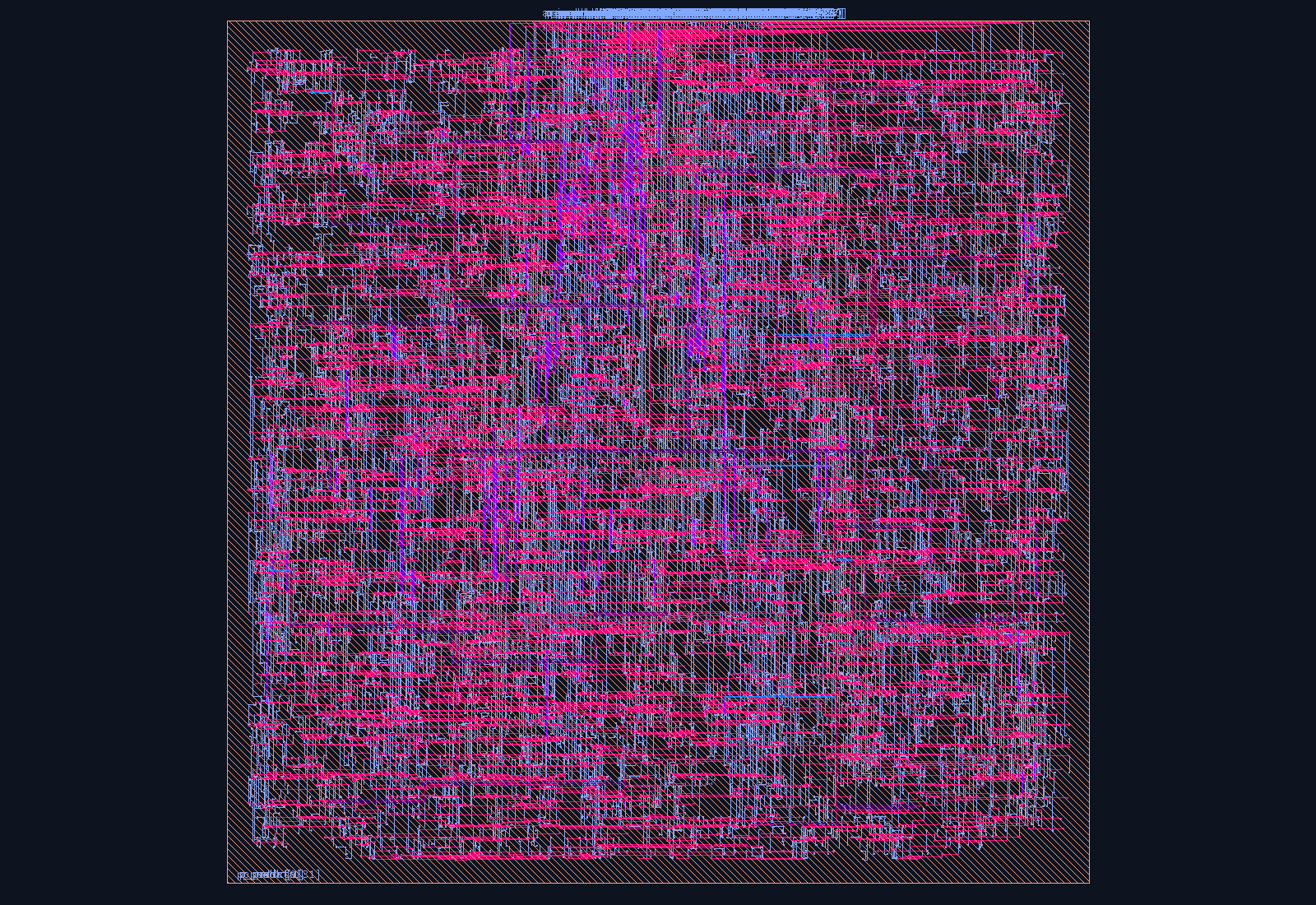
Physical implementation
What you’re licensing
ARINC 429 avionics-databus transmitter/receiver with label filtering and dual-FIFO word framing, ASIL-B / DO-254-ready. It is delivered as a licensable soft-IP block engineered as an ASIL-B Safety Element out of Context — not just RTL, but the complete functional-safety work package needed to carry it into an ISO 26262 program:
What it is
ARINC 429 avionics-databus transmitter/receiver with an APB4 slave interface and a rad-tolerant / ASIL-B safety monitor.
Key Features
- Hardware ARINC 429 word framing: LABEL[8]/SDI[2]/DATA[19]/SSM[2]/odd-PARITY[1] assembled and parsed in the TX_LOAD/RX_CHECK states, with dual bit-rate support (12.5 kbps / 100 kbps via CFG.HI_SPEED)
- 8-deep TX word FIFO and 8-deep SECDED-protected RX word FIFO (fifo_ecc) decouple the APB4 register plane from bit-serial wire timing; a double-bit RX FIFO fault reports err_code 2
- 8-entry RX label accept-list (LBL_FILT) filters unwanted labels in hardware before software ever sees them; off-list labels with good parity are silently dropped as normal operation
- External BPRZ line-driver/receiver boundary at tx_bit/tx_bit_en and rx_bit/rx_bit_en — the analog bipolar line signalling is entirely off-chip, so any HI-8585/DEI1082-class transceiver can be wrapped in
- CTRL.LOOPBACK self-test folds the TX serial bit into the RX deserializer, exercising serialize-parity-deserialize-check-filter-store end to end without an external bus
- Complementary-DMR lockstep across the TX and RX serdes FSMs (err_code 9) plus config-register even parity (err_code 1) and RX word odd-parity/framing detection (err_code 3), all latched by the shared safety_monitor
- APB4 register map (4-byte stride): CTRL 0x00, STATUS 0x04, CFG 0x08, TX_DATA 0x0C, RX_DATA 0x10, LBL_FILT 0x14, IER 0x18, ISR 0x1C (W1C), ERR 0x20 (W1C)
Standards & Compliance
ARINC 429 (Mark 33 DITS); DO-254/ED-80 airborne electronic hardware design-assurance framing; ISO 26262 ASIL-B SEooC
Functional Safety
ASIL-B (SEooC) · SPFM 92.43% · LFM 99.00% · PASS
ISO 26262-5 FMEDA method (transferable evidence for the RTCA DO-254 assurance case) · FMEDA available · Safety Manual included
Register Map
| Offset | Register | Description |
|---|---|---|
0x00 | CTRL | 0x04 STATUS 0x08 CFG 0x0C TX_DATA 0x10 RX_DATA |
0x14 | LBL_FILT | 0x18 IER 0x1C ISR(W1C) 0x20 ERR(W1C) [8:6]tx_state [11:9]rx_state [15:12]rxfifo level [19:16]txfifo level |
Getting Started
// Minimal instantiation
arinc429 #(
 .ADDR_W(6)
) u_arinc429 (
 .clk (clk),
 .rst_n (rst_n),
 // APB4
 .p_paddr (paddr),
 .p_psel (psel),
 .p_penable (penable),
 .p_pwrite (pwrite),
 .p_pwdata (pwdata),
 .p_prdata (prdata),
 .p_pready (pready),
 // Safety
 .err_clear (1'b0),
 .err_valid (err_valid),
 .err_code (err_code)
);
Configure via the CTRL register after reset to enable the IP and set operating parameters. Monitor err_valid / err_code for any safety faults reported by the built-in safety monitor.
Where it fits
Typically deployed in avionics, defense, and space systems built to the ARINC, MIL-STD, and CCSDS standards.
Why license it, not build it
Interested in ARINC 429 Avionics-Bus Transmitter/Receiver?
Pricing, the per-IP FMEDA, safety manual, and RTL data room are shared under a mutual NDA.
Figures are pre-silicon engineering-grade estimates for a Safety Element out of Context (SEooC); final ASIL sign-off is the integrator’s, supported under NDA. FMEDA and Safety Manual available under NDA.
circuit-design.space · +1-971-357-1400 · anovickis@circuit-design.space