Block diagram
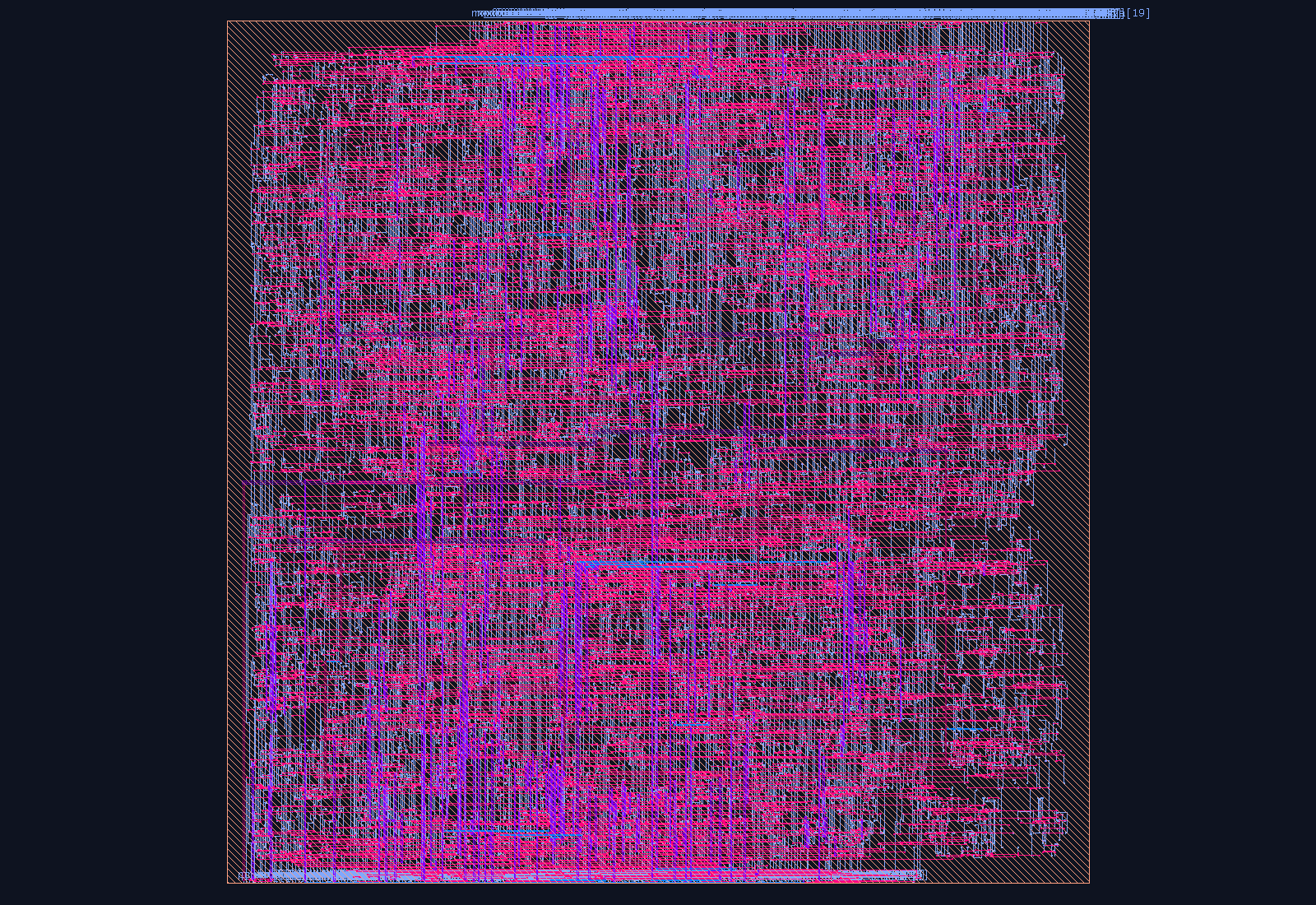
Physical implementation
What you’re licensing
Descriptor-ring DMA offload for CAN/CAN-FD RX/TX to system memory — pairs with can_fd, ASIL-B. It is delivered as a licensable soft-IP block engineered as an ASIL-B Safety Element out of Context — not just RTL, but the complete functional-safety work package needed to carry it into an ISO 26262 program:
can_dma is a synthesizable DMA engine that autonomously moves CAN/CAN-FD frames between a controller’s framed RX/TX interface and system memory — writing received frames into a circular ring and reading transmit frames from an indexed array — with no per-frame CPU intervention.
Key Features
- RX engine (R_IDLE→R_WR→R_ACK): on rx_frame_valid, streams the 4-word/16-byte frame (ID[28:0], CTRL[7:0], DATA_LO, DATA_HI) into a circular ring at RX_BASE+rx_ptr·16, wraps rx_ptr at RX_SIZE, increments the monotonic RX_HEAD, and pulses rx_frame_ack + RX_IRQ
- TX engine (T_IDLE→T_RD→T_SEND): a TX_TRIG index write fetches the 4-word descriptor at TX_BASE+idx·16 over the memory port and drives it out tx_frame_req/id/ctrl/data until tx_frame_ack, setting TX_DONE
- True 64-bit wide-word SECDED (ecc_pkg::ecc_enc64/ecc_dec64, 7 Hamming + 1 overall-parity check bits) over the full in-flight CAN payload each direction — any single-bit upset is corrected in-line, any double-bit → err_code 2 (combined with even parity over the 29-bit ID / 8-bit CTRL fields)
- Even parity over all eight addressing/config registers — CTRL, RX_BASE, rx_ptr, RX_HEAD, t_addr, tx_idx, RX_SIZE, TX_BASE — a mismatch raises err_code 1
- Independent complementary-DMR shadow FSM on both the RX and TX engines (diverse next-state cones, synthesis-kept against merging) → err_code 9, aggregated into the shared safety_monitor
- Single 32-bit-word combinational memory-master port (mem_addr/mem_wdata/mem_we/mem_re/mem_rdata) with fixed RX-write priority over a TX read — 4 cycles per frame each way; needs a 0-cycle SRAM or a registered bridge with a 1-deep read buffer
- Generic rx_frame_/tx_frame_ handshake — the same convention the catalog’s dronecan/arinc825/ecss_can protocol layers use above a CAN core — so it drops in behind any framed CAN/CAN-FD source; can_fd’s own RX/TX are APB-mapped registers today (RXID/RXCTRL/RXDATA/RXPOP, TXID/TXCTRL/TXDATA/TXREQ), so pairing the two needs a thin adapter
Standards & Compliance
ISO 11898-1 CAN 2.0B / CAN-FD frame format (payload carried, not re-validated); external ISO 11898-2/3 transceiver via the attached CAN core (e.g. can_fd); ISO 26262 ASIL-B SEooC
Functional Safety
ASIL-B (SEooC) · SPFM 91.40% · LFM 99.00% · PASS
ISO 26262:2018 · FMEDA available · Safety Manual included
Register Map
| Offset | Register | Description |
|---|---|---|
0x00 | CTRL | [0]=EN [1]=RX_EN [2]=TX_EN 0x04 RX_BASE 0x08 RX_SIZE(frames) 0x0C RX_HEAD(RO) |
0x10 | TX_BASE | 0x14 TX_TRIG(write idx) 0x18 STATUS [0]=RX_IRQ(W1C)[1]=TX_DONE(W1C)[2]=BUSY 0x1C IER |
Getting Started
// Minimal instantiation
can_dma #(
 .ADDR_W(6)
) u_can_dma (
 .clk (clk),
 .rst_n (rst_n),
 // APB4
 .p_paddr (paddr),
 .p_psel (psel),
 .p_penable (penable),
 .p_pwrite (pwrite),
 .p_pwdata (pwdata),
 .p_prdata (prdata),
 .p_pready (pready),
 // Safety
 .err_clear (1'b0),
 .err_valid (err_valid),
 .err_code (err_code)
);
Configure via the CTRL register after reset to enable the IP and set operating parameters. Monitor err_valid / err_code for any safety faults reported by the built-in safety monitor.
Where it fits
Typically deployed in in-vehicle networks, industrial gateways, and sensor/actuator links where a bus controller has to carry its own safety argument.
Why license it, not build it
Interested in CAN/CAN-FD Frame DMA Engine?
Pricing, the per-IP FMEDA, safety manual, and RTL data room are shared under a mutual NDA.
Figures are pre-silicon engineering-grade estimates for a Safety Element out of Context (SEooC); final ASIL sign-off is the integrator’s, supported under NDA. FMEDA and Safety Manual available under NDA.
circuit-design.space · +1-971-357-1400 · anovickis@circuit-design.space