Block diagram
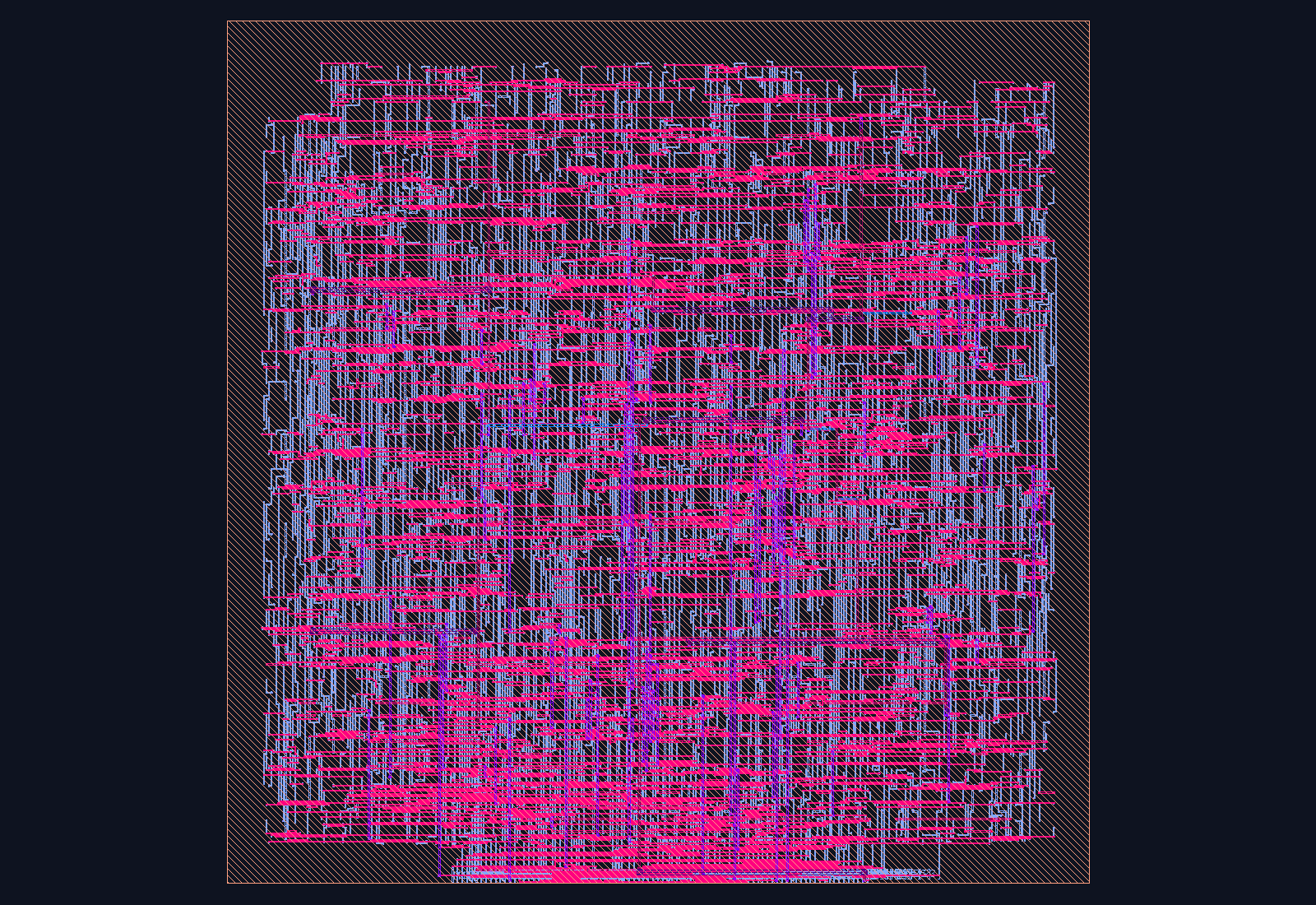
Physical implementation
What you’re licensing
APB4 machine-timer + software-interrupt block for RISC-V harts (mtime/mtimecmp → timer_irq, msip → sw_irq), ASIL-B safety-instrumented. It is delivered as a licensable soft-IP block engineered as an ASIL-B Safety Element out of Context — not just RTL, but the complete functional-safety work package needed to carry it into an ISO 26262 program:
What it is
A RISC-V Core-Local Interruptor (CLINT) delivered as synthesizable SystemVerilog soft-IP. It provides the machine-timer (mtime / mtimecmp → timer_irq) and machine-software interrupt (msip → sw_irq) required by the RISC-V privileged architecture, accessed over an APB4 slave interface.
Key Features
- 64-bit free-running mtime counter incremented by an external tick_i strobe, decoupled from the core clock; software may also preset it directly via MTIME_LO/MTIME_HI (0x10/0x14)
- Per-hart 64-bit mtimecmp (MTIMECMP_LO/HI, 0x08/0x0C) drives timer_irq_o = (mtime >= mtimecmp); resets to all-ones so no spurious timer interrupt can fire before firmware programs it
- Per-hart 1-bit MSIP register (0x00) drives sw_irq_o for software/inter-hart interrupts; both interrupt outputs are level-sensitive, wired directly to the hart’s mip.MTIP/mip.MSIP
- Complementary-redundant DMR shadow on the mtime time base (mtime_cmpl = ~mtime, KEEP_ATTR-protected through synthesis) flags a stuck or skewed counter as err_code 9
- Even parity over mtimecmp and msip, recomputed on every APB write, flags a corrupted compare threshold or software-IRQ bit as err_code 1
- Zero-wait-state APB4 slave (p_pready = p_psel & p_penable, p_pslverr tied 0) with a 5-register, 4-byte-stride map spanning 0x00-0x14
- Gate-level stuck-at fault-injection measured 100% single-point-fault detection across 418 flop fault sites, substantiating the FMEDA’s estimated 90-95% per-region diagnostic coverage
Standards & Compliance
RISC-V Privileged Architecture (CLINT mtime/mtimecmp/msip); companion to the RISC-V PLIC and ACLINT specifications; ISO 26262 ASIL-B SEooC
Functional Safety
ASIL-B (SEooC) · SPFM 96.38% · LFM 99.00% · PASS
ISO 26262:2018 · FMEDA available · Safety Manual included
Register Map
| Offset | Register | Description |
|---|---|---|
0x00 | MSIP | [0] software-interrupt pending (R/W) |
0x08 | MTIMECMP_LO | timer compare, low 32 bits (R/W) |
0x0C | MTIMECMP_HI | timer compare, high 32 bits (R/W) |
0x10 | MTIME_LO | timer value, low 32 bits (R/W) |
0x14 | MTIME_HI | timer value, high 32 bits (R/W) |
Getting Started
// Minimal instantiation
clint #(
 .ADDR_W(6)
) u_clint (
 .clk (clk),
 .rst_n (rst_n),
 // APB4
 .p_paddr (paddr),
 .p_psel (psel),
 .p_penable (penable),
 .p_pwrite (pwrite),
 .p_pwdata (pwdata),
 .p_prdata (prdata),
 .p_pready (pready),
 // Safety
 .err_clear (1'b0),
 .err_valid (err_valid),
 .err_code (err_code)
);
Configure via the CTRL register after reset to enable the IP and set operating parameters. Monitor err_valid / err_code for any safety faults reported by the built-in safety monitor.
Where it fits
Typically deployed in the safety backbone of an ASIL SoC — error detection, redundancy, and the fault-reaction path that takes the system to a safe state.
Why license it, not build it
Interested in CLINT — RISC-V Core-Local Interruptor?
Pricing, the per-IP FMEDA, safety manual, and RTL data room are shared under a mutual NDA.
Figures are pre-silicon engineering-grade estimates for a Safety Element out of Context (SEooC); final ASIL sign-off is the integrator’s, supported under NDA. FMEDA and Safety Manual available under NDA.
circuit-design.space · +1-971-357-1400 · anovickis@circuit-design.space