Block diagram
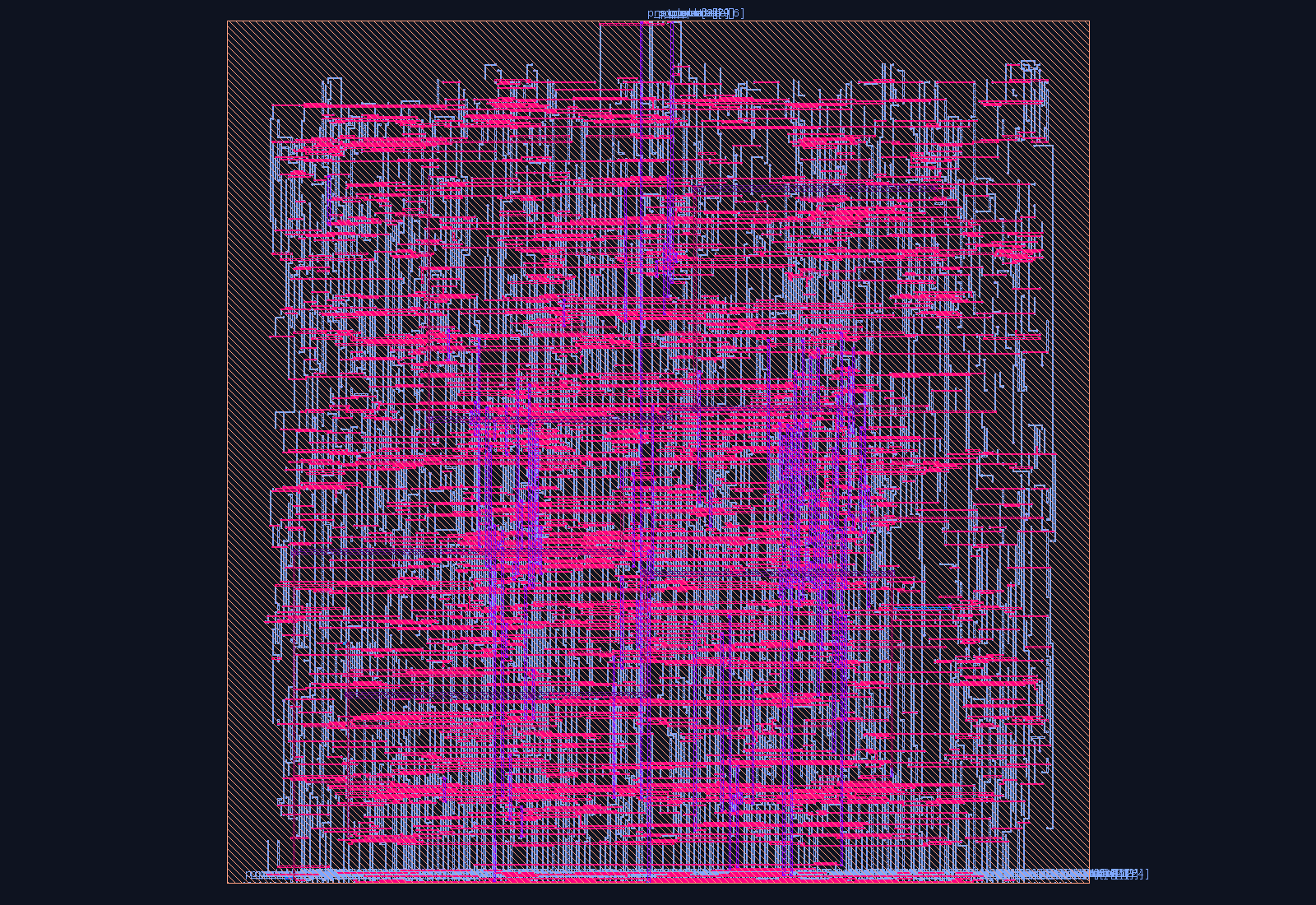
Physical implementation
What you’re licensing
Parity- and read-back-protected APB4 GPIO bank — ASIL-B diagnosed discrete I/O, drop-in foundry pad control. It is delivered as a licensable soft-IP block engineered as an ASIL-B Safety Element out of Context — not just RTL, but the complete functional-safety work package needed to carry it into an ISO 26262 program:
What it is
A parameterizable GPIO peripheral delivered as synthesizable SystemVerilog soft-IP.
Key Features
- Per-bit DIR/DOUT/DIN with atomic DSET/DCLR/DTGL (write-1-set/clear/toggle) — no read-modify-write races on the output register
- Edge (rising/falling/both, IBE) and level (active-high/low, IEVE/ITYPE) interrupts per pin, maskable via IER, OR’d into a single gpio_irq
- Foundry programmable-pad control selects — PADPU, PADPD, PADDS (DS_W bits/pin), PADST (Schmitt/hysteresis), PADSL (slew), PADIE (input buffer, resets all-on) — drop-in for a TSMC PDDWUWSWEWCDGS/PRWDWUW-class pad
- Per-pin output read-back diagnostic (RBEN, err_code 9): compares gpio_o/gpio_oe against the pad-looped-back gpio_i, 2-FF synchronized and 2-cycle persistence-filtered against switching noise
- Even-parity protection on all eight function-affecting config registers (err_code 1), recomputed atomically on every write including DSET/DCLR/DTGL
- Open-drain mode (ODE) drives low only and releases on a written 1, for shared bus lines such as an SMBus alert
Standards & Compliance
Generic ISO 26262 ASIL-B SEooC GPIO pattern
Functional Safety
ASIL-B (SEooC) · SPFM 92.40% · LFM 99.00% · PASS
ISO 26262:2018 · FMEDA available · Safety Manual included
Register Map
| Offset | Register | Description |
|---|---|---|
0x00 | DIR | 1=output, 0=input 0x20 DSET W1S: dout |= wdata (atomic set) |
0x04 | DOUT | output data 0x24 DCLR W1C: dout &= ~wdata (atomic clear) |
0x08 | DIN | RO: synchronized input 0x28 DTGL W1T: dout ^= wdata (atomic toggle) |
0x0C | IER | interrupt enable 0x2C ODE 1=open-drain, 0=push-pull |
0x10 | ISR | interrupt status (w1c) 0x30 PADPU 1=pull-up enable (pad select) |
…4 more registers — see datasheet for the full table.
Getting Started
// Minimal instantiation
gpio #(
 .ADDR_W(6)
) u_gpio (
 .clk (clk),
 .rst_n (rst_n),
 // APB4
 .p_paddr (paddr),
 .p_psel (psel),
 .p_penable (penable),
 .p_pwrite (pwrite),
 .p_pwdata (pwdata),
 .p_prdata (prdata),
 .p_pready (pready),
 // Safety
 .err_clear (1'b0),
 .err_valid (err_valid),
 .err_code (err_code)
);
Configure via the CTRL register after reset to enable the IP and set operating parameters. Monitor err_valid / err_code for any safety faults reported by the built-in safety monitor.
Where it fits
Typically deployed in the housekeeping layer every SoC needs — timing, watchdogs, reset, and I/O.
Why license it, not build it
Interested in GPIO Controller?
Pricing, the per-IP FMEDA, safety manual, and RTL data room are shared under a mutual NDA.
Figures are pre-silicon engineering-grade estimates for a Safety Element out of Context (SEooC); final ASIL sign-off is the integrator’s, supported under NDA. FMEDA and Safety Manual available under NDA.
circuit-design.space · +1-971-357-1400 · anovickis@circuit-design.space