Block diagram
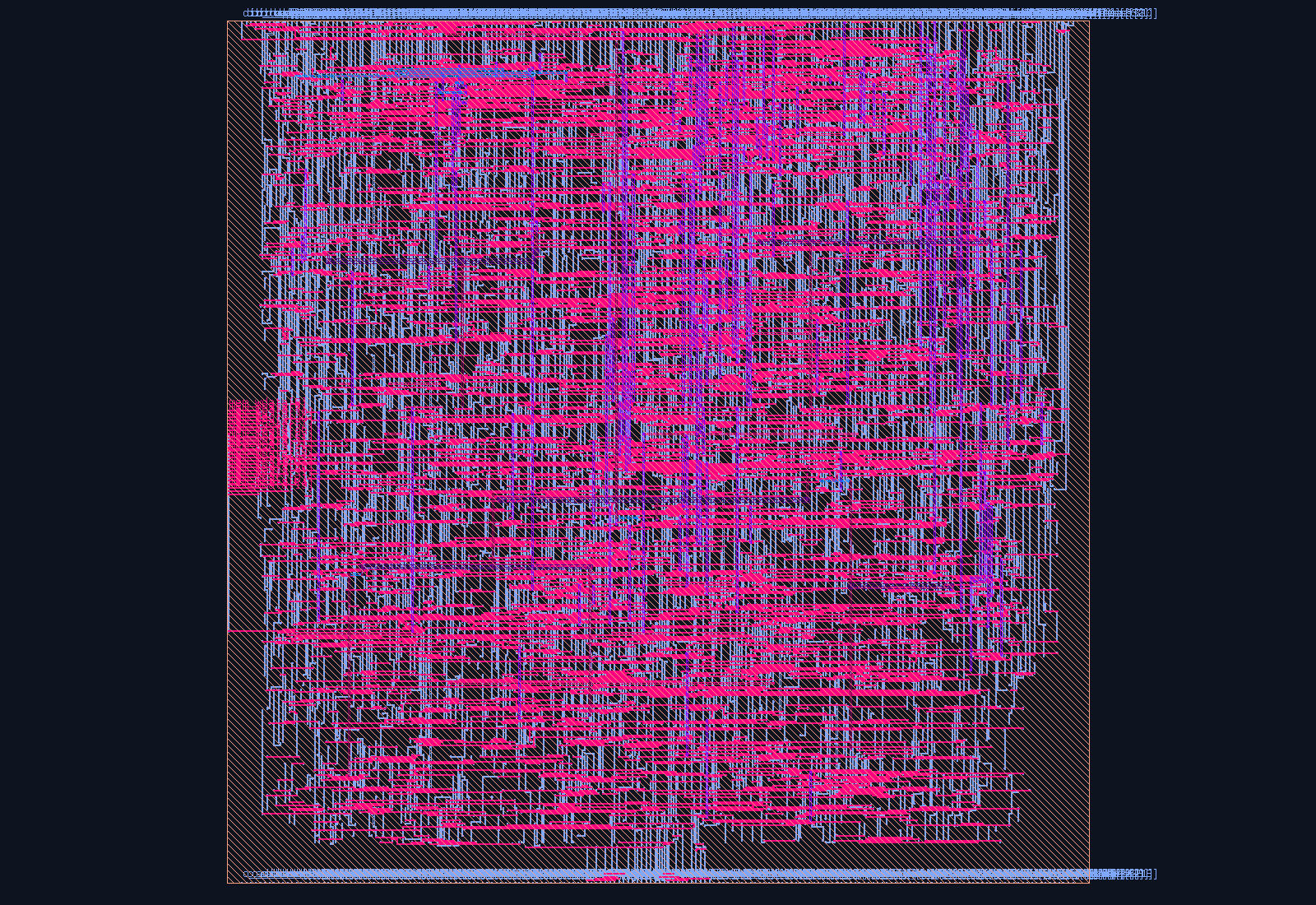
Physical implementation
What you’re licensing
The coherency point of a TileLink-C fabric — full 5-channel A/B/C/D/E handshake, address-indexed MSI directory, optional pipelined per-line acquires… It is delivered as a licensable soft-IP block engineered as an ASIL-B Safety Element out of Context — not just RTL, but the complete functional-safety work package needed to carry it into an ISO 26262 program:
1. Overview
The coherency point of a TileLink-C crossbar.
Key Features
- Full 5-channel TL-C handshake: AcquirePerm/AcquireBlock (A) → Probe (B) → ProbeAck/ProbeAckData (C) → Grant/GrantData (D) → GrantAck (E), plus voluntary Release/ReleaseData (C) → ReleaseAck (D), over an address-indexed MSI directory (dir_state[NUM_LINES][NM])
- Correct MSI downgrade semantics: an exclusive grow (NtoT/BtoT) probes every other holder toward N, a shared grow (NtoB) downgrades any exclusive holder to B; scan_j walks conflicting holders one at a time, each fully ProbeAck’d before the scan advances
- Optional BURST_BEATS-deep line buffer streams whole cache lines through GrantData/ProbeAckData/ReleaseData (BURST_BEATS=1 reproduces the single-beat v0.2 path); per-line Release via the c_address port targets any of the NUM_LINES lines independently
- Optional backing-SRAM port (mem_*, USE_BACKING_SRAM) read-allocates Grant data and writes dirty lines back one beat per cycle; a mem_wpar/mem_rpar parity pair closes the round-trip into err_code 2
- Optional second coherency engine (PIPELINE) processes an Acquire to a different directory line fully in parallel with the first; per-line ownership locks (line_lock0/1) guarantee at most one engine ever owns a line, preserving the single-Trunk invariant under concurrency
- ASIL-B safety: MSI directory parity (err_code 1), datapath parity across the GrantData output mux and the backing-SRAM round-trip (err_code 2), and diverse-DMR lockstep over both engines, the line buffer, beat counters, per-line locks and SRAM-port state (err_code 9), all latched by the shared safety_monitor
Standards & Compliance
TileLink-C coherence protocol (A/B/C/D/E channels, MSI cap encoding: T/B/N); ISO 26262 ASIL-B SEooC
Functional Safety
ASIL-B (SEooC) · SPFM 93.60% · LFM 90.00% · PASS
ISO 26262:2018 · FMEDA available · Safety Manual included
Register Map
See datasheet for full register reference.
Getting Started
// Minimal instantiation
tl_c_xbar #(
 .ADDR_W(6)
) u_tl_c_xbar (
 .clk (clk),
 .rst_n (rst_n),
 // APB4
 .p_paddr (paddr),
 .p_psel (psel),
 .p_penable (penable),
 .p_pwrite (pwrite),
 .p_pwdata (pwdata),
 .p_prdata (prdata),
 .p_pready (pready),
 // Safety
 .err_clear (1'b0),
 .err_valid (err_valid),
 .err_code (err_code)
);
Configure via the CTRL register after reset to enable the IP and set operating parameters. Monitor err_valid / err_code for any safety faults reported by the built-in safety monitor.
Where it fits
Typically deployed in heterogeneous SoCs that mix AMBA and TileLink IP and need clean, verified protocol and clock-domain crossings.
Why license it, not build it
Interested in TileLink-C Coherency Manager (tl_c_xbar)?
Pricing, the per-IP FMEDA, safety manual, and RTL data room are shared under a mutual NDA.
Figures are pre-silicon engineering-grade estimates for a Safety Element out of Context (SEooC); final ASIL sign-off is the integrator’s, supported under NDA. FMEDA and Safety Manual available under NDA.
circuit-design.space · +1-971-357-1400 · anovickis@circuit-design.space