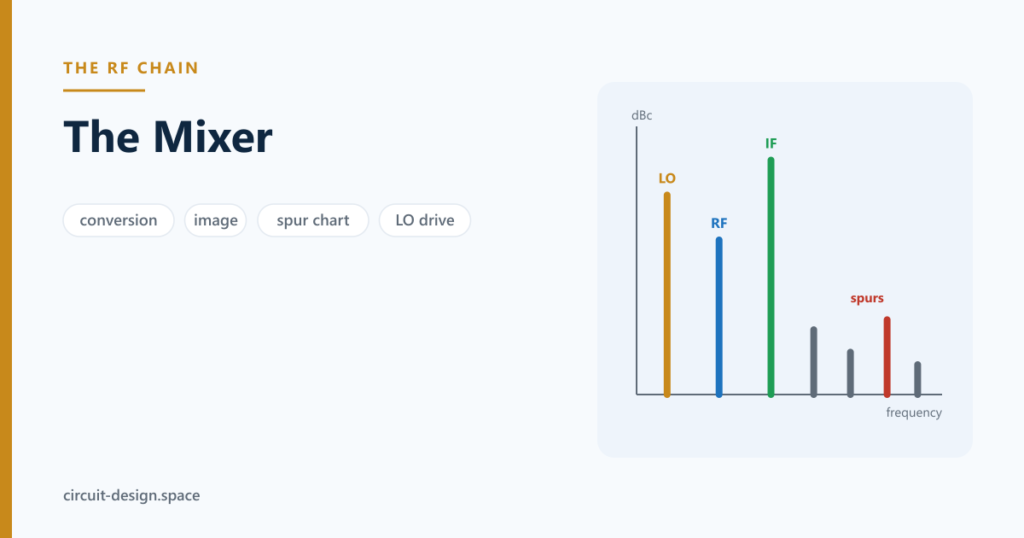
How mixers work and how they are specified — conversion gain and loss, the image problem and the architectures that solve it, the m×n spur chart, LO drive and why it sets linearity, port-to-port isolation, SSB versus DSB noise figure, and the topologies from diode ring to Gilbert cell. Read More
Category: Circuit Design
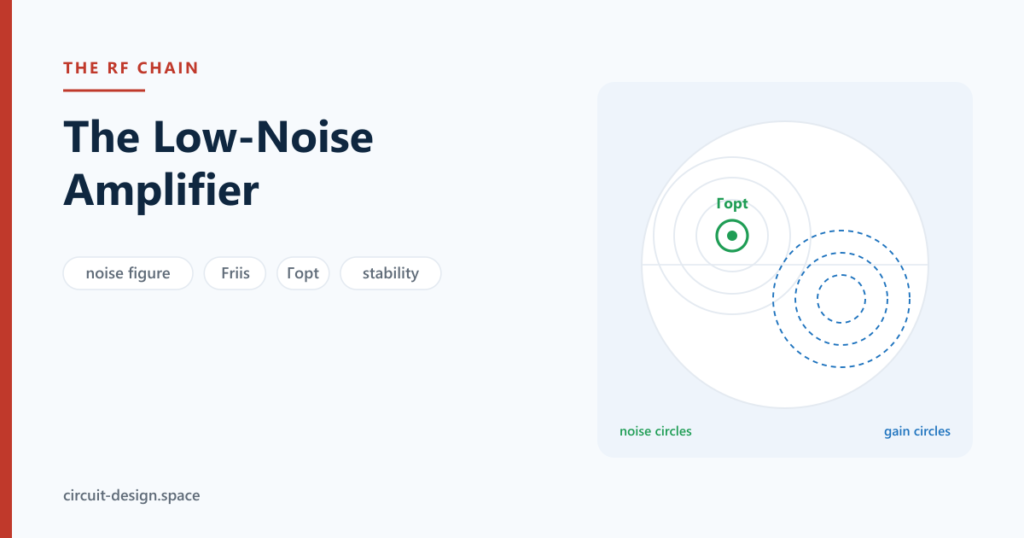
The Low-Noise Amplifier: Why the First Stage Decides Everything
How an LNA is specified and designed — noise figure and the Friis cascade, why the noise match is not the power match, stability, IP3 and the gain trade, the common topologies including inductively degenerated common-source and cascode, and the measurement discipline that keeps a claimed noise figure honest. Read More
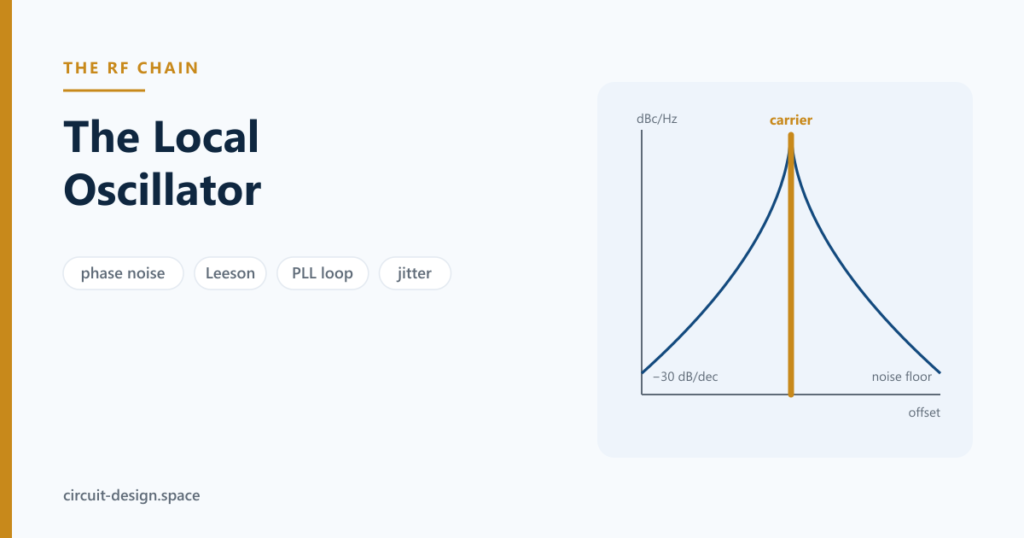
The Local Oscillator: Phase Noise, PLLs and Why the Clock Is Never Clean
How local oscillators and frequency synthesizers are designed and specified — phase noise and the Leeson model, reciprocal mixing, integer-N and fractional-N PLLs, loop bandwidth as the central trade, VCO topologies, spurs, lock time, and how phase noise becomes jitter. Read More