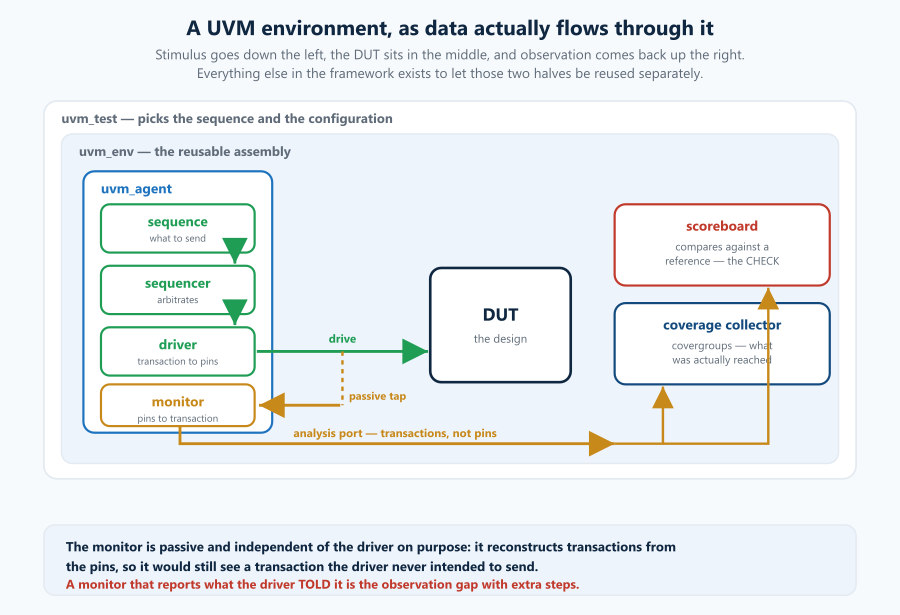
Follows on from testbench methods, which covers constrained-random, coverage and the checking problem in general. This article assumes those and is about the framework itself: what UVM is for, how its pieces fit, and — the part usually missing — when it is the wrong choice.
UVM is a class library and a set of conventions for building SystemVerilog testbenches. It is an IEEE standard (1800.2), it is supported by all three major simulators, and it is what most production verification environments are written in.
It is also routinely misunderstood in one specific way, so it is worth saying at the top: UVM does not make verification more correct. It makes verification more reusable. A UVM testbench and an ad-hoc SystemVerilog testbench that drive the same stimulus and make the same checks find the same bugs. What UVM buys is that the second block, the third derivative and the next project cost a fraction of the first — and if there is no second block, it has bought you nothing and charged you for the privilege.
Everything below follows from that.
1. The architecture, and why it is shaped that way
The hierarchy exists to separate what to send from how to send it, and what happened from whether it was right. Each seam is a place you can substitute one piece without touching the others, and that is the entire design rationale.
| Component | Its job | The seam it creates |
|---|---|---|
| sequence_item | one transaction, as data | protocol-independent stimulus description |
| sequence | what to send, in what order | reusable across environments |
| sequencer | arbitrates between competing sequences | lets several sequences share one interface |
| driver | turns transactions into pin wiggles | the only protocol-aware writer |
| monitor | turns pin wiggles back into transactions | passive, independent of the driver |
| agent | packages the four above | the unit of reuse |
| scoreboard | decides whether the answer was right | checking, separated from stimulus |
| coverage collector | records what was reached | measurement, separated from both |
| env | assembles agents and analysis | the reusable assembly |
| test | picks the sequence and configuration | the only thing that changes per test |
The monitor being passive is the most important structural decision in the list, and it is the one most often compromised under schedule pressure. The monitor reconstructs transactions from the pins — it does not ask the driver what it sent. That independence is what lets it catch a transaction the driver never intended to send.
A “monitor” that reports what the driver told it is not a monitor. It is the observation gap with extra ceremony: the scoreboard then compares the driver’s intention against the driver’s intention, and agrees.
2. The factory, which is the actual reuse mechanism
Everything else is structure; the factory is the mechanism.
Instead of my_driver drv = new(), UVM components are created through my_driver::type_id::create("drv", this). The indirection looks like ceremony until you need it, and then it is the whole point: a type override registered in a test replaces every instance of a class with a derived one, without editing the environment.
class err_driver extends axi_driver;
  `uvm_component_utils(err_driver)
  // ... same interface, deliberately misbehaves
endclass

class axi_error_test extends axi_base_test;
  function void build_phase(uvm_phase phase);
    set_type_override_by_type(axi_driver::get_type(),
                              err_driver::get_type());
    super.build_phase(phase);
  endfunction
endclass
That is a whole error-injection test written without touching the environment, the agent or any other test. Instance overrides do the same for one specific path rather than all of them.
The catch. The factory resolves by name at run time, so a typo in an override string produces no error — it silently does nothing, and the test passes having tested the unmodified design. Use the type-based forms (set_type_override_by_type) rather than the string ones wherever you can, and print the factory configuration during build_phase on any test that depends on an override.
3. config_db, the part everyone gets wrong
uvm_config_db is a global, string-keyed store used to pass configuration down the hierarchy — virtual interfaces, mode settings, agent active/passive state.
uvm_config_db#(virtual axi_if)::set(null, "uvm_test_top.env.agt*", "vif", vif);It works, it is universal, and it has a design flaw you will meet on your first day: the key is a string, the path is a wildcard pattern, and nothing is checked at compile time. A mistyped path fails silently — the get returns 0, the virtual interface is null, and the failure appears much later as a null-handle dereference in a component that is not the one at fault.
Three habits that make it survivable:
- Always check the return value —
if (!uvm_config_db#(...)::get(...)) `uvm_fatal(...), never a bareget. This single rule converts the worst debug experience in UVM into a clear message at the right moment. - Prefer a configuration object over a scatter of individual settings — one
my_env_confighandle passed down, with typed fields, rather than fifteen string keys. You get compile-time checking back for everything inside it. - Set as narrowly as you can. Wildcards that match more than intended are a real source of confusion, and
uvm_config_db::dump()is how you find out what actually matched.
4. Phasing and objections
UVM runs components through synchronised phases: build (top-down), connect (bottom-up), run (concurrent, consuming time), then extract, check and report.
The run_phase ends when nobody objects. Each component that has work outstanding raises an objection and drops it when finished:
task run_phase(uvm_phase phase);
  phase.raise_objection(this, "sending traffic");
  seq.start(env.agt.sqr);
  phase.drop_objection(this, "traffic done");
endtask
Two failure modes, and between them they account for a large share of new-user frustration:
- Nobody raises — the simulation ends at time zero with a passing result and no traffic. A test that finishes suspiciously fast is this, essentially always.
- Somebody never drops — the simulation hangs until the timeout. Always pass a description string;
phase.get_objection().display_objections()then tells you who is still holding.
A drain time (phase.phase_done.set_drain_time) keeps the run alive briefly after the last objection drops, so in-flight responses reach the scoreboard rather than being cut off. Omitting it produces intermittent end-of-test mismatches that look like a design bug.
5. Sequences, and the layer above them
A sequence generates transactions. The useful structure is that sequences compose:
- Base sequences do one thing — a burst write, a config read, a reset.
- Layered sequences call other sequences, building scenarios from primitives.
- Virtual sequences coordinate several sequencers, which is how you express “start a DMA on the AXI port while the APB port reconfigures the controller”. This is where the real system-level scenarios live, and it is the point at which UVM starts earning its cost on an SoC.
Sequencer arbitration decides what happens when several sequences want the same interface: FIFO order by default, or priority, weighted, or a user-defined scheme. It is a real knob and it is frequently left at the default when the test intent needed something else.
Where people over-engineer. A sequence library with deep inheritance and heavy randomisation constraints becomes hard to reason about, and a constraint solver failure in a five-level hierarchy is genuinely unpleasant to debug. Keep the hierarchy shallow; prefer composition over inheritance.
6. The register abstraction layer
RAL is a model of the design’s register map: fields, access policies, reset values, address maps. It gives you model.ctrl.enable.write(status, 1) instead of a raw bus transaction, plus front-door and back-door access, automatic mirroring, and a set of generated tests — reset values, bit-bash, aliasing — that check the register map for free.
It is the highest-value single feature in UVM for a block with a substantial register map, for a reason unrelated to the abstraction: the model is generated from the same source as the RTL registers and the documentation — IP-XACT, SystemRDL, or a house format — so the three cannot drift apart. Register-map drift is one of the most common and most embarrassing classes of bug, and a generated RAL removes it by construction.
The cost is real: the generation flow has to exist, and hand-writing a RAL model is miserable and will itself drift. If there is no single source for the register map, fix that first — the RAL is a consequence of it, not a substitute.
7. When UVM is overkill
This is the section most UVM material leaves out.
UVM has a large fixed cost — the framework, the agents, the base classes, the RAL flow — and a low marginal cost per subsequent block. Ad-hoc testbenches have almost no fixed cost and a high marginal one. With plausible figures, the curves cross around four blocks or derivatives sharing the same agents.
The numbers are illustrative. The shape is not, and it gives a usable rule:
Use UVM when you have an IP family or a chip with many similar interfaces; when the same protocol appears in several places; when verification will be reused across derivatives or handed to a customer; when the team already knows it; or when you are delivering IP and the environment is part of the deliverable.
Do not use UVM when it is one small block with one interface and no successor; when the design is a datapath best attacked by a reference model and directed vectors; when the whole verification effort is two weeks (the framework will not amortise); when nobody on the team has used it and the schedule has no room for the learning curve; or when formal is the better tool and a testbench is not really needed at all.
The failure mode worth naming: a UVM testbench built for its own sake on a block that did not need one, where the team spends its budget on framework and its checking ends up thin. That lands squarely in the strong-stimulus/weak-checking quadrant, and it passes.
8. What is genuinely hard about it
Honest list, because these are the costs nobody quotes:
- The learning curve is weeks, not days. Factory, config_db, phasing, TLM ports and sequences are five unfamiliar mechanisms that interact. Expect a month to competence and longer to fluency.
- Error messages are poor. A null virtual interface reports as a null-handle dereference somewhere unrelated. A failed factory override reports as nothing whatsoever.
- Compile and elaboration time on a large environment is minutes, which is felt on every iteration.
- Debug is indirect. The path from “this transaction was wrong” back to the sequence that produced it goes through several layers of indirection that exist for reuse rather than for your convenience today.
- It is verbose. A trivial agent is several hundred lines of boilerplate, which is why every team eventually has generators or snippets — and why the generated code is worth reviewing rather than trusting.
9. The alternatives, briefly and fairly
Plain SystemVerilog. For one block with one interface, a clean 500-line testbench with a scoreboard and covergroups is easier to write, easier to debug and entirely legitimate. Most of UVM’s value is reuse you have not got.
cocotb / pyuvm. Testbenches in Python against any simulator. Wins on developer velocity, on the ecosystem — real libraries for maths, protocols and file formats — and on the learning curve. Loses on constrained-random solving (no native SystemVerilog constraint solver), on simulator performance at the boundary, and on the fact that your next engineer is more likely to know UVM. Increasingly credible for blocks and for anything algorithm-heavy.
Formal-first. For control logic, arbiters, FIFOs and protocol compliance, writing SVA and proving it can be both faster and stronger than building a testbench at all. A great many blocks would be better served by less simulation and more formal.
Vendor verification IP. For a standard protocol, buy the agent. Writing an AXI or PCIe VIP to production quality is a project in itself, and the compliance suite that comes with it is evidence you can hand to somebody else.
10. A method for adopting it
- Decide it is worth it first — the payback curve above, with your own numbers for blocks, derivatives and reuse.
- Start from an existing environment, your own or a vendor’s, rather than from a blank file.
- Get the register map generated before writing the RAL. Everything downstream depends on the single source.
- Build one agent properly, with a genuinely passive monitor, and reuse it. The first agent sets the pattern every later one copies, including its mistakes.
- Write the checking before the stimulus. Scoreboard and assertions first; it is the half that decides whether any of it means anything, and it is the half that gets squeezed.
- Prove the testbench can fail — inject a bug, watch it get caught. Do this before you trust a single passing run.
- Add coverage from the verification plan, not from what is convenient to instrument.
- Keep sequences shallow. Composition over inheritance.
11. The pitfalls
- Building a UVM environment for a block that will never be reused.
- A monitor that reports what the driver sent rather than what the pins did.
- A bare
uvm_config_db::getwith no return check. - A factory override with a mistyped string, silently doing nothing, in a passing test.
- No objection raised: a test that passes in zero time.
- An objection never dropped: a hang that looks like a design bug.
- No drain time, and intermittent end-of-test mismatches that look like one too.
- A hand-written RAL model that has drifted from the RTL.
- Deep sequence inheritance nobody can debug when a constraint fails.
- Spending the budget on framework and shipping thin checking.
Glossary
Agent — The reusable package of sequencer, driver and monitor for one interface. The unit of reuse in UVM, and the thing worth building carefully because every later agent copies its pattern.
Analysis port — The broadcast connection a monitor uses to publish transactions to any number of subscribers — scoreboard, coverage, logging. One-to-many and non-blocking, which is why adding a subscriber never perturbs the existing ones.
config_db — The global, string-keyed configuration store. Universal, and unchecked at compile time, which makes an unchecked get the most common source of a confusing null-handle failure in the framework.
Driver — Turns transactions into pin activity. The only protocol-aware writer in the environment, and deliberately the only one.
Factory — The creation-by-proxy mechanism that makes overrides possible. The actual reuse engine: it is what lets a test swap a component for a derived one without editing the environment.
Objection — The mechanism that keeps run_phase alive. Nobody objecting ends the simulation immediately, which is why a test that passes in zero time is nearly always a missing raise_objection.
Phase — The synchronised stages every component moves through: build, connect, run, extract, check, report. Build runs top-down and connect bottom-up, which is not arbitrary — a component must exist before anything can connect to it.
RAL — The register abstraction layer: a model of the register map giving symbolic access, mirroring, and generated register tests. Most valuable when generated from the same source as the RTL, because that removes register-map drift by construction.
Sequence — A generator of transactions, composable into layered and virtual sequences. Keep the hierarchy shallow; a constraint failure five levels deep is genuinely hard to debug.
Sequencer — Arbitrates between sequences competing for one driver. Its arbitration mode is a real design knob and is usually left at the default.
Scoreboard — Where the checking lives: compares observed transactions against a reference. Everything else in the framework is structure; this is the part that decides whether the testbench is worth anything.
TLM port — The transaction-level connection between components, so they exchange objects rather than signals. What makes a component replaceable without touching its neighbours.
Type override — Replacing every instance of a class with a derived one, from the test. The cleanest way to write an error-injection test, and silent when its string form is mistyped.
Virtual sequence — A sequence coordinating several sequencers at once. Where genuine system-level scenarios are expressed, and where UVM starts justifying its cost on an SoC.
Related reading
- Testbench methods — constrained-random, coverage, and the checking problem this article assumes
- TLA+ for hardware — the protocol level above RTL, and where a counterexample becomes a directed sequence
- The ASIC design flow — where verification sits in the schedule and what it costs
- The FMEDA work package — fault injection, where the observation-gap problem is measured rather than argued
Further reading
Book links below are Amazon affiliate links: if you buy through one we earn a small commission at no extra cost to you. It does not influence what is recommended — the same books were on this list before the links were.
- Chris Spear and Greg Tumbush, SystemVerilog for Verification — the language foundation UVM is built on. Read this before the UVM books.
- Ray Salemi, The UVM Primer — the gentlest route in, building up one component at a time.
- Vanessa Cooper, Getting Started with UVM: A Beginner’s Guide — practical and example-driven.
- Sharon Rosenberg and Kathleen Meade, A Practical Guide to Adopting the Universal Verification Methodology — written by people who built it; strongest on the why behind the structure.
- The IEEE 1800.2 standard and the Accellera UVM reference implementation — the authority when the books disagree, which they do.
Have a verification environment that costs more than it catches, or an IP family where the second block should have been cheap and was not? That’s what we do. Reach us at circuit-design.space.
circuit-design.space · +1-971-357-1400 · anovickis@circuit-design.space